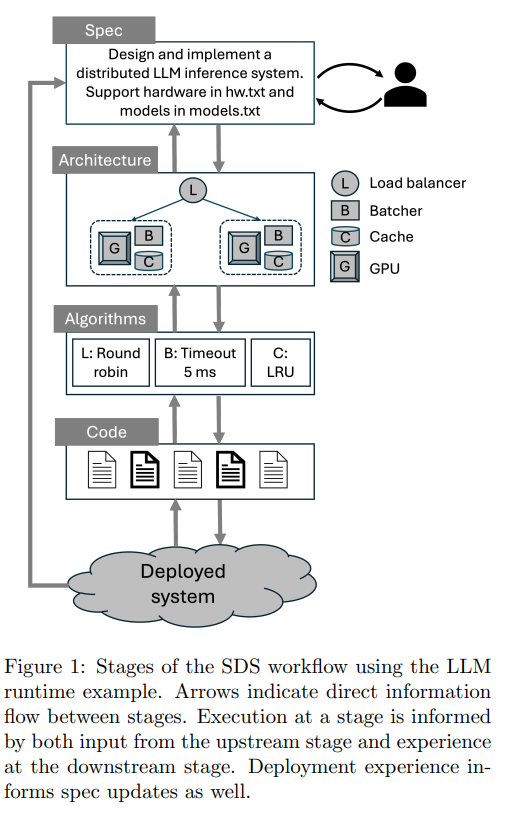
Self-Defining Systems (SDS) by Thomas Anderson, Ratul Mahajan, Simon Peter, and Luke Zettlemoyer is a bold proposal for AI-driven systems research.
In SDS, agentic “engineers” get the system specification and operating environment specification, then design and build the systems to spec. Crucially, as the specification or environment changes, an army of agents should notice and make adjustments quickly to ensure the system continues to meet these evolving specifications. The paper calls it Time to Integrate (TTI), and the goal is to shorten this time with an army of agentic “engineers” trying all kinds of changes, optimizations, and improvements in response to environmental or spec changes. The paper falls short of a precise definition of the process, and the proposed grand vision boils down to the same agentic loop we have seen before: try a change, evaluate, repeat. What makes this vision different is the idea that agents will not only implement the spec but also evolve it to align with the realities of the operating environment, making the loop more like: change the spec, implement the change, evaluate the systems in the current environment, repeat.